 Dansk
Dansk 
Textiles Took Centre Stage at LOOP Forum
Producer responsibility, recycling and new partnerships shaped the conversations as Tekstilretur met the textile industry at LOOP Forum.
Date: May 9th 2026
Textiles played a major role at this year’s LOOP Forum. On the stages, in the exhibitions and in the many conversations between companies, organisations and stakeholders from the textile and waste sectors.
For Tekstilretur, the event also became a clear confirmation of how rapidly the debate around upcoming extended producer responsibility for textiles and footwear is moving forward.
Just two weeks after launching the new producer responsibility organisation, we experienced significant interest from producers, industry organisations, recyclers, and other stakeholders across the circular value chain.
Over two days at our stand, we spoke with companies trying to understand the upcoming requirements, with actors working in sorting and recycling, and with organisations already attempting to define their role in the future system.
Here are some of the key impressions and discussions we are taking away from LOOP Forum.
When durability and recyclability collide
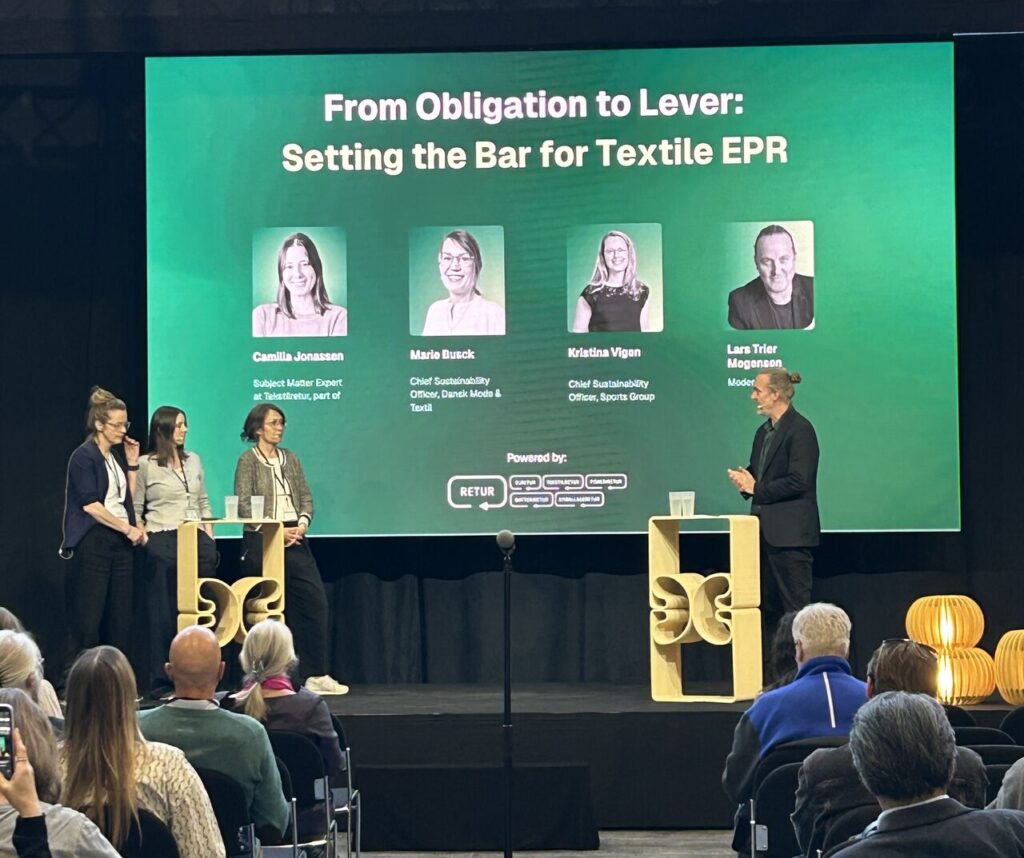
Tekstilretur hosted a Main Stage debate on extended producer responsibility for textiles and footwear and the opportunities and dilemmas that come with it.
In the debate, From Obligation to Lever: Setting the Bar for Textile EPR, we discussed the level of ambition the upcoming producer responsibility system for textiles and footwear could have.
At the same time, the debate focused on whether producer responsibility can be designed as a structural lever for building a circular textile market, and which barriers, dilemmas, and opportunities the industry is facing.
The panel featured Kristina Vigen, Chief Sustainability Officer at Sports Group Denmark, Marie Busck, Chief Sustainability Officer at DM&T, and Camilla Jonassen, Subject Matter Expert at Tekstilretur.
The debate was moderated by political commentator and host of the DR podcast Guld og grønne skove, Lars Trier Mogensen.
One of the central themes of the debate was the balance between durability and recyclability.
Among other things, the discussion highlighted a fundamental dilemma in the circular transition of the textile industry: many of the fibre blends and material compositions that provide textiles with high quality and long lifespans also make recycling more difficult.
On the other hand, textiles based on mono-materials are easier to recycle, but not necessarily as durable or functional over time.
This means that producer responsibility is not only about waste management, but also about product design, material choices, and priorities across the entire value chain.
The issue also resurfaced in many of the conversations at the stand.
Several companies explained that they are already trying to navigate which material choices make sense in a future market where durability, reuse, and recyclability are all expected to become increasingly important.
Reuse first. But what happens afterwards?
Another central topic – both in the debate and in the conversations throughout LOOP Forum – was the waste hierarchy and the question of what should happen to textiles once they can no longer be reused.
There was broad agreement that textiles should first and foremost remain in use for as long as possible, because reuse ranks higher in the waste hierarchy than recycling.
At the same time, it was also clear that all textiles eventually reach the end of their lifespan. As a result, questions around recycling capacity and future treatment solutions became recurring topics throughout the two days.
Several participants pointed out that Europe still lacks real large-scale textile recycling capacity, and that further development will therefore require investment, volume and long-term solutions.

Producer responsibility must also work in practice
Economics and competitiveness were also major themes, both on stage and in the many conversations with companies.
Several participants emphasised that producer responsibility will only succeed if it becomes practically feasible and financially attractive for companies to transition.
In particular, eco-modulation, where companies are financially rewarded for making more circular choices, was highlighted as a potentially important tool.
At the same time, concerns about administrative burdens and documentation requirements were prominent throughout the discussions at LOOP Forum.
Many companies are already trying to understand what kinds of requirements may be introduced and how extensive the expected documentation processes will become.
A recurring message in both the debate and the conversations was therefore that companies need to experience a real financial incentive for making more circular choices, while the system itself must remain realistic and workable in practice.
The Nordics must create volume for textile recycling
The need for investment and cross-border collaboration was another major topic throughout the event.
From Tekstilretur’s perspective, collective schemes are expected to play a key role in building the necessary recycling capacity for textiles in Europe.
Today, the market for large-scale textile recycling remains limited, and there is therefore a need for long-term investment in new facilities and treatment capacity.
Tekstilretur is already in dialogue with sister organisations in Norway, Sweden and Finland to create larger and more stable flows of textile waste across the Nordic region.
The goal is to create the volume and predictability necessary for the waste management and recycling industry to invest confidently in large-scale solutions.
Producer responsibility has moved from future scenario to reality
Extended producer responsibility for textiles and footwear is no longer a future scenario.
The level of interest was evident throughout the conference among companies, industry organisations, waste operators and technology providers alike.
Many people stopped by our stand to ask questions, share experiences and discuss solutions and collaborations. Thank you for that.
The discussions have begun, the industry is moving, and the question is no longer whether producer responsibility is coming, but how we design it in a way that can help move the textile industry in a more circular direction.

